News

socSMCs/EUCognition Summit "Social cognition in humans and robots"

September 27-28, 2018, UKE Hamburg, Germany

Information and registration

September 27-28, 2018, UKE Hamburg, Germany

Information and registration

Entorhinal cortex receptive fields are modulated by spatial attention, even without movement

Grid cells in the entorhinal cortex have been identified to encode an animal's position in space, but have been hypothesized to play a more fundamental role in mental operations. A prerequisite for this is that they can be activated in the absence of movement. Here, we investigated whether firing fields of entorhinal cells are activated by movements of covert attention, in the absence of any physical movement. For , we recorded the neuronal activity of 141 neurons in the entorhinal cortex of two rhesus macaque monkeys performing a covert attention tracking task. The results reveal that movement of covert attention, without any physical movement, also elicits spatial receptive fields with a triangular tiling of the space.

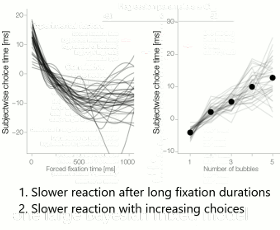
Probing the temporal dynamics of the exploration-exploitation dilemma of eye movements

When scanning a visual scene, we are in a constant decision process regar

ding whether to further exploit the information content at the current fixation or to go on and explore the scene. In , Ehinger et al. investigated how the experimental control of fixation durations affects the balance between exploiting a current view and exploring the environment by performing a new saccade. To test this, they developed a new paradigm that allows for experimental control over fixation durations and exploration behavior. Using a large Bayesian mixed model, they show an exponential decay in the fixation time and a logarithmic increase in the number of future fixation locations. This shows that sampling and processing of the current stimulus are exhausted for long fixation durations, biasing toward faster exploration.

Human Decisions in Moral Dilemmas are Largely Described by Utilitarianism: Virtual Car Driving Study Provides Guidelines for Aut

Due to the necessity of implementing moral decisions in autonomous driving vehicles
(ADVs), we conducted a set of driving experiments in virtual reality. The participants experienced unexpected unavoidable dilemma situations with human-like avatars of different ages and group sizes and in
a variety of circumstances and had to decide who was to be spared. Derived from the findings, which show that participants, in general, decide in a utilitarian manner, we argue for the necessity of obligatory ethics setting implemented in ADVs. [link to the paper]

Performance similarities predict collective benefits in dyadic and triadic joint visual search

When humans perform tasks together, they may reach a higher performance in comparison to the best member of a group (i.e., a collective benefit).

In this study, we investigated collective benefits for joint visuospatial tasks. We tested whether dyads and triads reach a collective benefit when they are forbidden to exchange any information while performing the task and whether interindividual performance similarities predict collective benefits.
We found that dyads reached a collective benefit. Triads did outperform their best individual member and dyads – yet, they did not outperform the best dyad pairing within the triad. In addition, similarities in performance significantly predicted the collective benefit for dyads and triads.

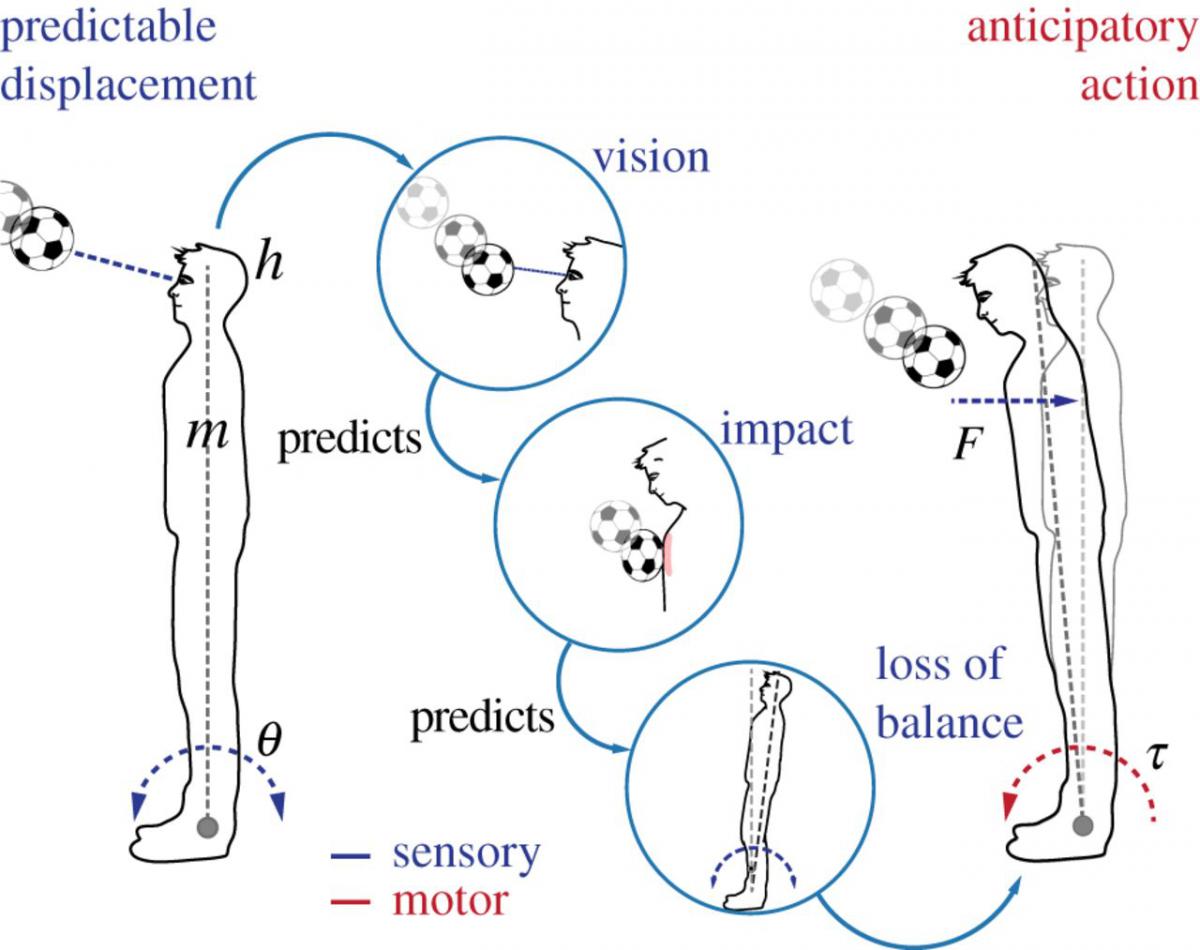
The perceptual shaping of anticipatory actions

Humans display anticipatory motor responses to minimize the adverse effects of predictable

perturbations. A widely accepted explanation for this behavior relies on the notion of an inverse model that, learning from motor errors, anticipates corrective responses. Here, we propose and validate the alternative hypothesis that anticipatory control can be realized through a cascade of purely sensory predictions that drive the motor system, reflecting the causal sequence of the perceptual events preceding the error. We compare both hypotheses in a simulated anticipatory postural adjustment task. We observe that adaptation in the sensory domain, but not in the motor
one, supports the robust and generalizable anticipatory control characteristic of biological systems. Our proposal unites the neurobiology of the cerebellum with the theory of active inference and provides a concrete implementation of its core tenets with great relevance both to our
understanding of biological control systems and, possibly, to their emulation in complex artefacts.

Can limitations of visuospatial attention be circumvented? - Yes!

Humans are bombarded with visual input – yet, their attentional capacities for proc

essing this input are severely limited.
Here we provide a review of 1) studies on limitations of visuospatial attention and their physiological correlates, 2) studies in multisensory research investigating whether limitations in visuospatial attention can be circumvented by distributing information processing across several sensory modalities, and 3) research from the field of joint action that has investigated how limitations of visuospatial attention can be circumvented by distributing task demands across people and providing them with multisensory input.

Sound joined actions in rowing and swimming

This Bookchapter introduces the method of Sonification as a tool for studying intercorporeality and enactment.

This Bookchapter introduces the method of Sonification as a tool for studying intercorporeality and enactment. Providing additional auditory information about a movement supports motor perception as well as the control of movements, and enables the acting individual as well as observers to perceive the movement in exactly the same way via audition, thus establishing a common percept for all interaction partners.

Deep representation learning for human motion prediction and classification

Generative models of 3D human motion are often restricted to a small number of activities and can therefore not generalize well to novel movements or applications.

In this work Bütepage et al. propose a deep learning framework for human motion capture data that learns a generic representation from a large corpus of motion capture data and generalizes well to new, unseen, motions. The method outperforms the recent state of the art in skeletal motion prediction.
 

Pages

Subscribe to RSS - News